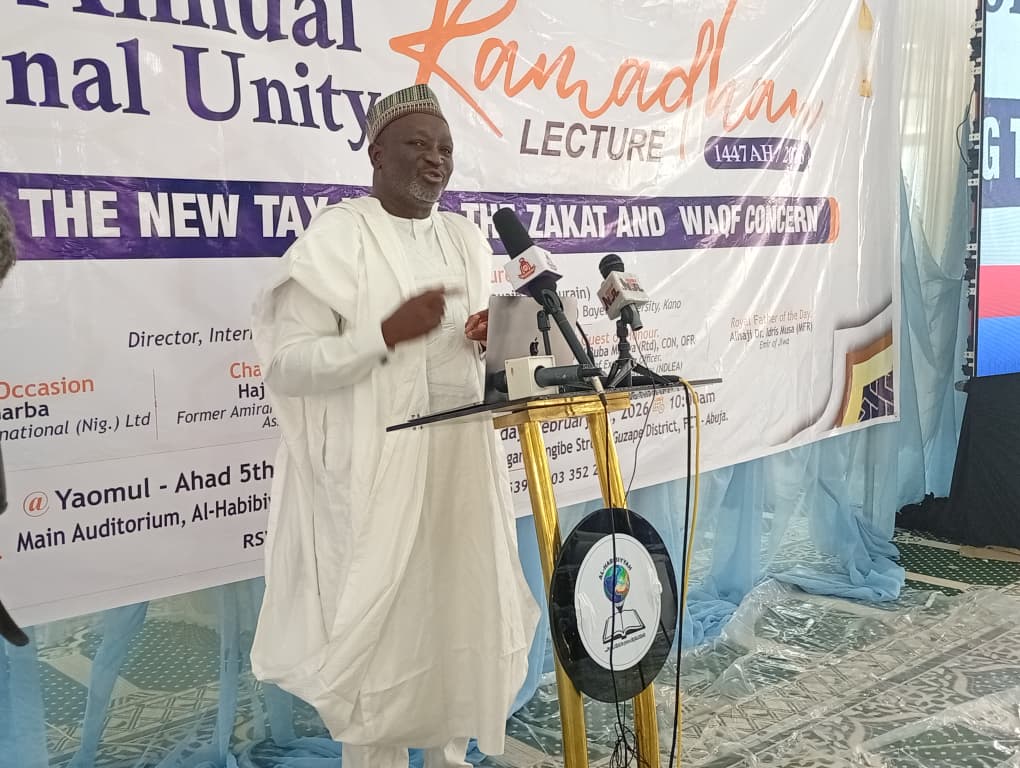
The Al-Habbiyyah Islamic Society has appealed to the Federal Government to review aspects of the new tax laws affecting Zakat and Waqf (Islamic endowment), noting that both are already compulsory charitable obligations under Islamic law.
The appeal was made during the Society’s 23rd Annual National Unity Ramadan Lecture held at its headquarters in Abuja.
The lecture, themed “Making the New Tax Work: The Zakat and Waqf Concern,” focused on the implications of the new tax regime on Islamic charitable practices.
Zakat is one of the five pillars of Islam. It is a mandatory form of charity that every financially capable Muslim is required to give annually. Beyond purifying wealth, it is intended to promote social equity and compassion. Zakat is typically calculated as 2.5 per cent of savings and certain assets held for one lunar year and is distributed to specific categories of beneficiaries outlined in the Qur’an, including the poor, the needy and those in debt.
Waqf, on the other hand, refers to a permanent charitable endowment in Islam. It involves donating property, land, money or other assets for the sake of Allah. The endowed asset is neither sold nor inherited, while the proceeds or benefits generated from it are channelled towards charitable causes such as the construction of mosques, schools, hospitals and water facilities.
Responding to questions from journalists, Chairman of the Ramadan Lecture Committee, Mallam Sulaiman Ali, said taxing Zakat and Waqf would amount to double taxation, as they are already obligatory charitable contributions for Muslims. He added that some advanced countries exempt religious and charitable contributions from taxation in recognition of their social value.
In his remarks, the Chief Imam of Al-Habbiyyah Mosque, Imam Fuad Adeyemi, explained that the essence of the lecture was to draw the government’s attention to the new tax reforms introduced by President Bola Tinubu, urging the authorities to consider exempting Zakat and Waqf from taxation.
According to him, these charitable obligations are structured to support both Muslims and non-Muslims, particularly the less privileged, thereby contributing to poverty eradication and national development.
“Paying tax on Zakat and Waqf amounts to double taxation because they are already contributions meant to support vulnerable members of society. That is why we organised this lecture — to educate and sensitise the administration to either adopt a flexible approach in taxing them or remove them from the list of taxable items,” he said.
Guest speaker, Professor Usman Shu’aib, underscored that the primary objective of Zakat and Waqf is poverty alleviation and social welfare. He cautioned that imposing tax on them could undermine their effectiveness and overall impact.
“This is why we consider it necessary to call the attention of the government to review the process by consulting tax experts to either exempt them from taxation or reduce the burden, as these are funds willingly contributed by Muslims to help eradicate poverty,” he added.
The new tax laws, signed in June 2025, came into effect on 1 January 2026. The legislation includes the Nigeria Tax Act, Nigeria Tax Administration Act, Nigeria Revenue Service (Establishment) Act and Joint Revenue Board (Establishment) Act, which collectively seek to reform and strengthen Nigeria’s tax administration system in line with global best practices.
Source: VON – https://von.gov.ng/al-habbiyyah-urges-tax-review-on-zakat-waqf/
Leave a Reply